

Publications/News
Select a tab below to view our latest Journal Articles, Conferences, News Media and Podcasts
Journal Articles
Peer-reviewed scientific literature
Informing the Space Between Zero and One: a Standardised, Scat-Based Approach to Monitoring Changes in Habitat Use by Brush-Tailed Rock-Wallabies
Phillips, Stephen, Katherine Howard, and Jade Krause. (2022). Informing the Space Between Zero and One: a Standardised, Scat-Based Approach to Monitoring Changes in Habitat Use by Brush-Tailed Rock-Wallabies (Petrogale penicillata). Australian Mammalogy 44(1), pp.161-168.
Quantifying the impacts of bushfire on populations of wild koalas (Phascolarctos cinereus): Insights from the 2019/20 fire seaso
Phillips, S., Wallis, K. and Lane, A. (2021). Quantifying the impacts of bushfire on populations of wild koalas (Phascolarctos cinereus): Insights from the 2019/20 fire season. Ecological Management & Restoration, 22(1), pp.80-88.
Multiple paternity and precocial breeding in wild Tasmanian devils, Sarcophilus harrisii (Marsupialia, Dasyuridae)
Russell, T., Lane, A.M., Clarke, J., Hogg, C., Keeley, T., Morris, K., Madsen, T. Ujvari, B. (2019). Multiple paternity and precocial breeding in wild Tasmanian devils, Sarcophilus harrisii (Marsupialia, Dasyuridae). Biological Journal of the Linnean Society, 128, pp. 201-210. https://doi.org/10.1093/biolinnean/blz072.
Integrating long-distance dispersal into vertebrate conservation planning: scaling relationships and parentage-based dispersal analysis in the koala
Norman, J. A., Phillips, S. S., Blackmore, C. J., Goldingay, R., and Christidis, L. (2019). Integrating long-distance dispersal into vertebrate conservation planning: scaling relationships and parentage-based dispersal analysis in the koala. Conservation Genetics 20, pp. 1163–1174.
MHC diversity and female age underpin reproductive success in an Australian icon, the Tasmanian Devil
Russell, T., Lisovski, S., Olsson, M., Brown, G., Spindler, R., Lane, A., Keeley, T., Hibbard, C., Hogg, C., Thomas, F., Belov, K., Ujvari, B and Madsen, T. (2018). MHC diversity and female age underpin reproductive success in an Australian icon, the Tasmanian Devil. Scientific Reports 8(1). DOI: 10.1038/s41598-018-20934-9.
The remaining koalas (Phascolarctos cinereus) of the Pilliga forests, north-west New South Wales: refugial persistence or a population on the road to extinction?
Lunney, D., Predavec, M., Sonawane, I., Kavanagh, R., Barrott-Brown, G., Phillips, S., Callaghan, J., Mitchell, D., Parnaby, H., Paull, D.C. and Shannon, I. (2017). The remaining koalas (Phascolarctos cinereus) of the Pilliga forests, north-west New South Wales: refugial persistence or a population on the road to extinction?. Pacific Conservation Biology,23(3), pp.277-294.
Conferences
NSW Koala Research Symposium
Expert Panel for Habitat Use, Impacts and Management
Invited Workshop for evaluating the effectiveness of vehicle-strike mitigation measures on koala populations
Invited workshop on fire impacts and management strategies
Download Poster presentation

NSW State Koala Conference: The Vanishing
Australian Mammal Society Conference
Author:
Steve Phillips, Grant Brearley, Amanda Lane, Kirsty Wallis
Abstract:
Copies of presentations given by Biolink staff at the 65th Annual Scientific Meeting of the Australian Mammal Society (2019).
Abstracts of the presentations are as follows;
Killing them softly with our song… negative outcomes arising from the management of disease in peri-urban koalas (Dr Steve Phillips)
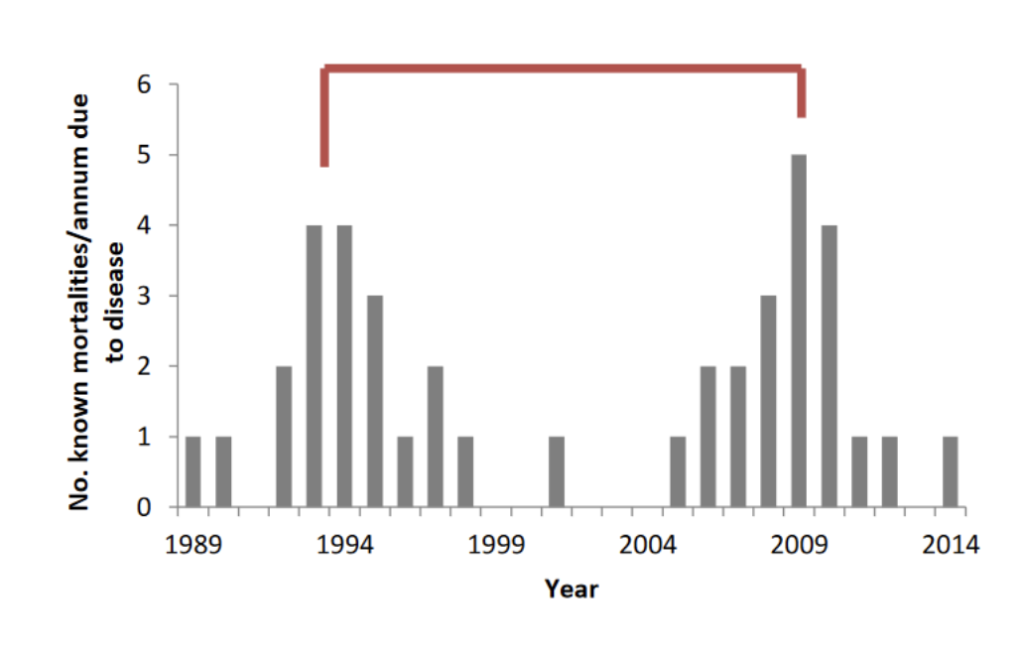
Since its discovery in the mid-1970s, diseases collectively considered under the umbrella of Chlamydiosis have been perceived as a serious threat to the viability and conservation status of most free-ranging koala populations in eastern Australia. But if this is really true and notwithstanding other biotic considerations – why are koalas still relatively widespread across their remaining geographic range? Current solutions to the management of Chlamydiosis in free-ranging koala populations range from antibiotic therapies and the development of specialized vaccines, to the euthanasia of diseased animals, all of which are implemented and/or being undertaken in an attempt to improve the reproductive capacity and health of populations so affected. Using longitudinal hospital data collected over the last 20 – 30 years, we demonstrate ongoing koala population viability against a cyclical background of disease-mediated mortalities in a koala population on the far north coast of NSW, as well as the facilitation of near endangerment of a regionally significant population in south-east Queensland by poorly informed euthanasia practices. Moreover, there is little benefit in attempting to control disease if the causal factors that contribute to its prevalence / expression are not effectively managed in the first instance. It is time for a new song.
News
Biolink in the news media
Interview – Sydney Morning Herald
Is it too late to save an Aussie icon from extinction? I asked ‘Dr Koala’
Peter FitzSimons
Fears Sydney koalas on road to extinction as ‘devastating’ statistic revealed
Sydney Basin koala colonies are in jeopardy
Fears Shoalhaven’s koalas wiped out in fires
Fire ravages northern NSW koala population
Koala policy should back landholders
Koala losses from recent NSW bushfires ‘One of the most significant biodiversity impacts in our history’
Podcasts
The frontline of koala conservation
The imminent threat to our national icon, the koala
ABC Late Night Live – Phillip Adams
My shrinking home – the story of the Koala
Back from the Brink podcast