What we do
Records Analysis
Analysis of historical wildlife records to inform conservation management and planning outcomes
Records Analysis

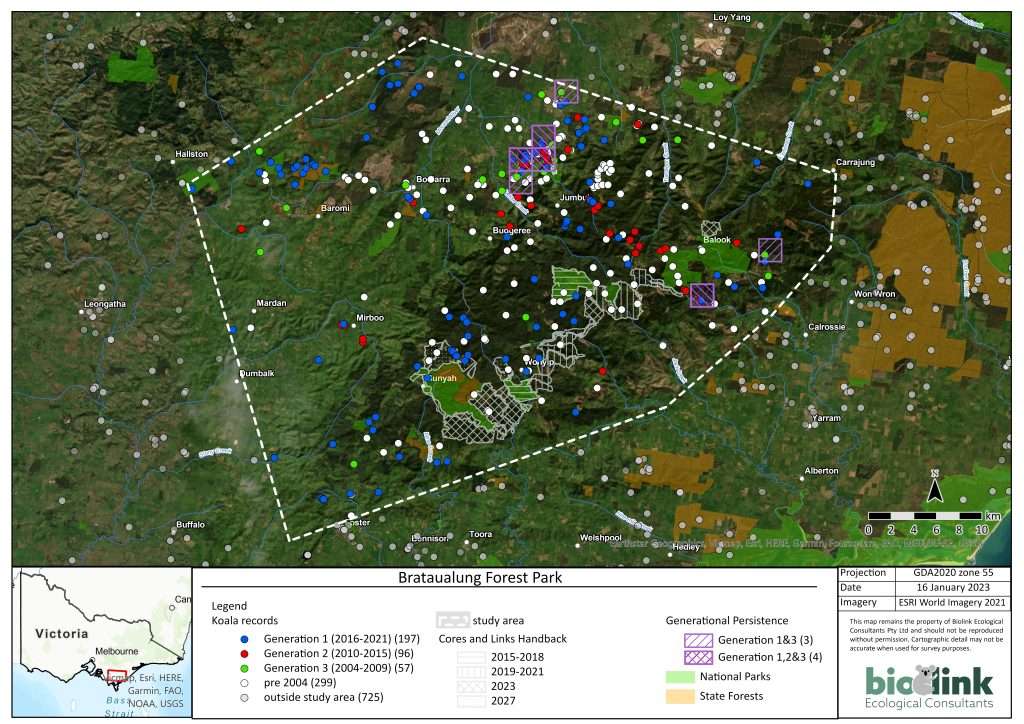
One outcome of heightened public interest in wildlife is the ongoing input of wildlife sightings into publicly accessible databases such as Atlas of Living Australia (ALA) and Bionet, via the use of phone apps such as I Spy Koala and iNaturalist. Consequently, analyses of historical wildlife records are increasingly being used to inform planning outcomes as these analyses can provide an understanding relating to changes in distribution, abundance and locations of historic and contemporaneous local source populations, particularly with regard to threatened species.
Quantitative range parameters Extent of Occurrence (EoO) and Area of Occupancy (AoO) are two measures pertaining to the spatial distribution of a species, the EoO being the area encapsulating the outermost geographic limits in which the species can be found, while the AoO is the proportional area within the EoO in which the species actually occurs. Historical records can also be used to examine the persistence of metapopulations over time by way of Generational Persistence Assessment (GPA) which examines historical data for records of species reoccurring in a localised area over a time period which exceeds the lifespan individual animals, so identifying the likely presence of long-standing source populations.
These analyses, to which we apply methodological constraints to account for issues of observer density and potential bias, are aligned with the International Union for Conservation of Nature (IUCN) and Commonwealth-based conservation criteria which place weight on the concept of population change over a time period of three consecutive (taxon-specific) generations. Such analyses are frequently conducted to contextualise the results of field survey and other data such as threats / vehicle-strike analyses.